
Last Updated: September 1, 2026
AI is changing how work is performed, how people are communicating, learning, shopping and consuming; moving from recommendation systems and personal assistants to sophisticated healthcare devices and fully autonomous vehicles, artificial intelligence is increasingly becoming an integrated and implicit part of society and individuals’ lives.
The exponential acceleration in AI’s application to society has been accompanied by increasing concerns over fairness, privacy and the locus of accountability, as well as the ability of society to retain human control over potentially transformative intelligence.
Everyone, especially businesses, governments, developers and end users, should understand the ethical issues of AI as it can provide many benefits, while how effectively it is applied is crucial, depending on its responsible development, application, and supervision.
This Article Belongs to AI Application
Table of Contents
What Are the Ethical Issues of AI?
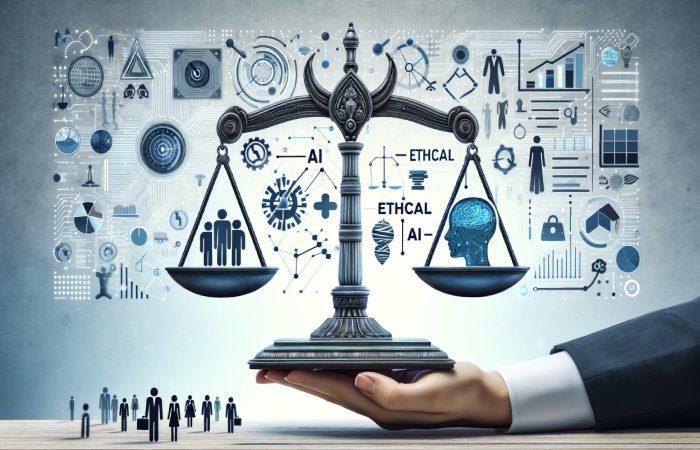
Ethical Issues in AI pertains to whether an AI system is designed and implemented in a manner that is fair, transparent, secure, accountable and is sensitive of human rights.
The ways in which we rely on the technology means that AI may have a positive impact in our jobs, health care and other areas, however it has a potentially serious effect on our lives, whether its personal, the workplace and society. The problems AI may create or reinforce in society will occur if systems are not used properly and as such not ethically.
Major Ethical Issues of Artificial Intelligence
| Ethical Issue | What It Means | Potential Impact |
| AI Bias | AI results in unfair outcomes due to biased data or design. | Discrimination and unequal treatment |
| Privacy | Information about people: collected, processed, or inferred by AI. | Loss of personal privacy |
| Lack of Transparency | Users may not understand how an AI system reaches a decision | Reduced trust and accountability |
| Job Displacement | Automation can replace or significantly change some jobs | Employment disruption |
| Accountability | It can be unclear who is responsible for AI-generated decisions | Difficulty addressing harm |
| Security | AI systems can be manipulated or misused | Fraud, cyberattacks, and other risks |
| Misinformation | Generative AI can create convincing false content | Confusion and loss of trust |
1. Bias and Discrimination
One topic that is highly debated is the ethical implications of AI bias. Since the systems are trained through machine learning they learn trends within the given data set, which may incorporate social and historical biases. If not addressed, the system can therefore yield unfair results.
If, for instance, it’s given historical hiring information with underlying bias, an AI-based system for recruiting could select specific types of candidates unfairly. But this can occur in other types of automated decision-making, such as loan applications or even medical diagnoses or facial recognition.
Developers must measure AI systems across diverse groups, while always seeking to observe how they’re being used.
2. Privacy and Data Protection

The requirements for a large amount of data that is input into the AI applications can raise issues concerning the collection, storing, processing and sharing of private data.
AI programs can use data from websites, devices, cameras, applications and many other sources. In certain circumstances, it can also infer certain undesirable properties of personal data from the apparent properties of normal data.
When it comes to creating responsible AI, developers will be guided by concepts of data protection: collect only information that’s needed, safeguard information, clarify to whom information is given and how it’s used and comply with privacy laws as appropriate.
3. Lack of Transparency
People may struggle to work with some AI. For example, if you are given a suggestion or decision from an algorithm, you would want to know why this decision was reached.
This is of particular importance when AI systems are deployed in high-impact scenarios, for example: healthcare, financial services, recruitment, or public services.
In fact high transparency can include logging of the system process with explanations being concise and transparent, and appropriate human verification being implemented.
4. Job Displacement and the Future of Work
Automated systems backed by AI could execute jobs that were once done by people. While this has the ability to boost workplace output, it would alter the nature of work altogether.
Not all of the jobs are likely to just go away. Many others will more than likely transform with the assistance of an AI; it will take care of the repetitive chores and allow human skills to excel in communication, creativity, judgment and critical thinking.
From an ethical point of view, firms have a duty of care with regard to employee training and reskilling and to a managed process of workforce change, when implementing AI.
5. Accountability for AI Decisions
A major question is: Who is responsible when an AI system causes harm?
AI is built by developers, deployed by organizations and ultimately used by people, raising complex issues of accountability.
Good governance is therefore vital. Organizations must establish clear lines of ownership for the approval, monitoring, auditing and rectification of the AIs they are responsible for. Human governance must continue to be paramount in important decision-making contexts using AI.
6. AI-Generated Misinformation
Generative AI introduces additional risks that require dedicated risk-management practices. NIST’s Generative AI Profile provides guidance for identifying and managing risks associated with generative AI.
Deep-fakes, AI-generated misinformation are used to defame or discredit individuals and have also been used to manipulate public discourse and make it difficult for people to separate real and fabricated content.
Important claims need to be checked by the users. AI creators and platforms should foster a responsible content ethic and proper restraints.
7. Security and Misuse of AI
There is potential for AI to be used for good purposes, including detecting fraud and cybersecurity awareness and enhancements. There is also a risk, however, that these advances will also be exploited for scams, automated hacking, impersonation, or illegal purposes.
Security therefore needs to be a principle embedded throughout the AI development lifecycle, and cannot be a separate activity conducted only after a service has been launched.
How Can AI Be Used Ethically?
| Responsible AI Practice | Why It Matters |
| Use representative and high-quality data | Helps reduce unfair outcomes |
| Conduct regular audits | Identifies risks and performance problems |
| Protect personal information | Reduces privacy risks |
| Maintain human oversight | Keeps people involved in important decisions |
| Explain AI decisions where appropriate | Builds trust and accountability |
| Monitor systems after deployment | Detects emerging problems |
| Establish clear governance | Defines responsibility for AI use |
Why Ethical AI Matters
AI ethical is not just about ensuring technology doesn’t pose risks. It’s also about designing technologies that people can be confident in. The growing use of AI in fields such as space research also highlights the importance of responsible and ethical AI development.
Organizations that embrace ethics will better placed to anticipate risks, manage them responsibly and meet users’ expectations; citizens who understand the ethics of AI can navigate the technology landscape with confidence.
The goal is not to cease the development of AI, rather, a development that operates with adequate guardrails, transparency, accountability, and human discretion.
Conclusion
Ethical Issues of AI is making their way in other sectors of our lives. These challenges include biased decisions, ethical issues related to privacy, transparency of AI systems, risks of unemployment due to automation, the role of responsibility in the field of AI, the spread of fake news, and threats relating to safety.
AI is able to do amazing things in order to increase productivity and solve complex problems; but we have a duty to ensure this new potential remains aligned with human values. When combined with technical innovation, human ingenuity, and human compassion, we can create AIs that benefit all members of humanity.